

NEWS AND UPDATES
The latest updates regarding our products and our company

How to Choose an Operation Theatre Surgical Light
Choosing an Operation Theatre Surgical Light is a clinical decision, not a simple equipment purchase. Surgeons need stable, shadow-reduced illumination during long and delicate procedures. Nurses need controls that remain intuitive under pressure. Biomedical teams need dependable performance, service access, and documented safety information.
A useful evaluation begins at the operating table. Observe how the light moves, locks, and responds to sterile-handle adjustments. Check whether the beam stays focused when staff reposition the arm. Examine color rendering, brightness control, heat management, and illumination depth. A wound should appear clear, without distracting glare or uncomfortable heat. Review the manufacturer’s test data, warranty terms, maintenance requirements, and compliance with applicable medical-device standards.
Do not judge the lamp from a showroom alone. Ask surgeons to assess tissue color and shadow control during realistic procedures. Ask nurses whether the controls are easy to clean and operate. Ask engineers about preventive maintenance and replacement parts. These practical voices often reveal weaknesses that brochures hide. No model is perfect. A brighter light may still perform poorly after incorrect positioning. Advanced controls may also confuse unfamiliar users. The best choice balances optical performance, ergonomic design, reliability, and total ownership cost. This guide explains the details that deserve careful attention before installation. It also highlights common assumptions that may need reconsideration. A trusted supplier should provide evidence, responsive technical support, and clear training. That standard protects workflow quality and supports safer surgical care.
Types of Operation Theatre Surgical Lights and Their Main Functions
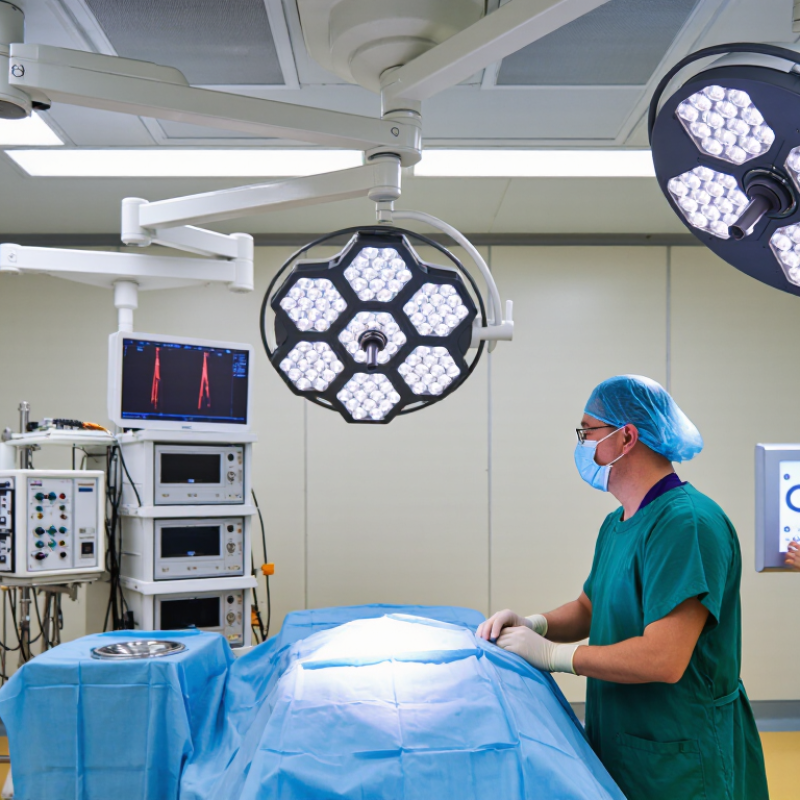
Choosing an operation theatre surgical light begins with understanding how each type supports a different clinical task. Ceiling-mounted lights are common in major theatres. They provide strong, stable illumination above the operating table. Single-head models suit focused procedures, while double-head systems cover wider surgical fields. Their articulated arms allow precise positioning without interrupting staff movement.
Mobile surgical lights offer flexibility for minor theatres, emergency rooms, and facilities with changing room layouts. They usually include lockable casters, rechargeable batteries, and adjustable intensity. Battery duration matters during power interruptions. A wall-mounted light can save ceiling space, but its movement range may be limited. LED sources are now widely preferred because they produce less radiant heat and support long service life. Still, low heat does not mean zero heat.
Important functions include shadow reduction, color rendering, adjustable color temperature, and sterile handle control. High color rendering helps surgeons distinguish tissue tones accurately. Multiple light fields can reduce shadows when hands or instruments block the beam. A deep-cavity procedure needs strong penetration, not merely high brightness. Excessive intensity may cause eye fatigue, so smooth dimming is essential.
In practical theatre planning, I would check the light at the actual table height, not only on a specification sheet. Ceiling strength, cleaning access, backup power, and arm movement deserve equal attention. A frequent mistake is choosing a bright model that feels awkward to reposition. Staff feedback can reveal this problem quickly. Test it with gloves on. Even excellent lighting can fail when controls are difficult to reach.
Key Lighting Specifications for Surgical Procedures
How to Choose an Operation Theatre Surgical Light
Key Lighting Specifications for Surgical Procedures
A surgical light should reveal tissue colour without creating glare or deep shadows. IEC 60601-2-41:2021 identifies 40,000 to 160,000 lux as the central illuminance range for surgical luminaires. That range sounds broad. Procedure type, cavity depth, and surgeon preference still matter. Colour temperature between 3,000K and 5,000K usually supports natural-looking tissue tones. A high colour-rendering index is also important, especially for red tissue. Review both Ra and R9 values, not Ra alone. The National Electrical Manufacturers Association notes that saturated red rendering can expose weaknesses in general CRI testing.
During commissioning, measure illumination at the operating surface, not only in a catalogue test. Check the field after sterile handles, staff movement, and table adjustments change the light angle. Shadow dilution deserves equal attention. Multi-source optics can maintain visibility when a hand or instrument blocks part of the beam. However, more light is not always better. Excessive brightness may increase eye fatigue, particularly during long procedures. There is room for judgement here.
Tips: Request independent photometric data. Confirm illuminance, CCT, Ra, R9, beam diameter, shadow performance, and dimming range. Test controls with gloved hands. Inspect the light at eye level for glare. Ask maintenance staff whether calibration records are practical. A perfect specification does not guarantee a perfect theatre. Real workflow may disagree.
How to Assess Room Layout, Mounting, and Installation Requirements
How to Choose an Operation Theatre Surgical Light
How to Assess Room Layout, Mounting, and Installation Requirements
Room layout should guide the surgical light decision. Mark the operating table, anesthesia zone, imaging equipment, doors, and ceiling services on one drawing. The light must reach the wound without crossing the anesthesia workspace. Leave clear movement paths for staff and equipment. Small rooms need careful arm positioning. Space disappears quickly.
Check the ceiling before selecting a mounting system. A reinforced concrete slab may support a fixed mount, while a suspended ceiling usually needs structural reinforcement above it. Do not rely on ceiling panels. They are not load-bearing. Confirm the support capacity with a qualified structural engineer, especially for dual-head systems. Also inspect ceiling height, service ducts, sprinklers, and air diffusers. A beautiful layout can still create airflow problems.
Installation planning should include electrical circuits, emergency power, control locations, and cable routing. Keep controls reachable, but away from frequent contact during sterile procedures. Verify the light’s reach with a full-size mock-up or taped floor plan. This simple step can reveal collisions that drawings miss. I have found that installation teams often focus on mounting strength and overlook cleaning access. That is a real weakness. Allow enough clearance to wipe handles, joints, and nearby ceiling surfaces. Follow applicable electrical, medical, and infection-control requirements. Have the clinical engineering team inspect, test, and document the installation before use.
Evaluating Sterilization, Safety, and User Control Features
How to Choose an Operation Theatre Surgical Light
Sterilization begins with surfaces, not brightness. Surgical lights should have sealed housings, smooth joints, and removable sterile handles. Avoid deep grooves where blood or disinfectant residue can collect. CDC guidance states that cleaning must precede disinfection, because organic material reduces disinfectant effectiveness. This matters during rapid turnovers. The WHO Global Guidelines for the Prevention of Surgical Site Infection report an 11% infection rate among surgical patients in low- and middle-income countries. That figure makes cleanability a clinical concern, not merely a purchasing detail.
Safety requires more than strong illumination. Check heat output near the wound, shadow control, emergency power behavior, and electromagnetic compatibility. IEC 60601-2-41:2021 provides safety and performance requirements for surgical luminaires. User controls should remain usable with sterile gloves. Consider adjustable intensity, color temperature, focus, and sterile-handle controls. A foot control can reduce unnecessary movement, but it may also confuse new staff. Training is still necessary. I have seen advanced panels ignored when controls were poorly labeled.
Tips: Ask staff to test the light during a simulated procedure. Wipe every reachable surface with the facility’s approved disinfectant. Confirm contact times. Check whether handles tolerate repeated sterilization or require protective covers. Request cleaning instructions, photometric test results, and battery specifications. Do not judge only by lux readings; a bright field can still create glare. A perfect light is unlikely. The safer choice is the one staff can clean, control, and trust under pressure.
Comparing Maintenance Needs, Standards, and Total Operating Costs
How to Choose an Operation Theatre Surgical Light
A surgical light should be judged by its maintenance plan, not only its brightness. During theatre assessments, engineers inspect the light’s arm movement, sterile handle, lens surface, and shadow control. Small faults matter. A loose arm can interrupt a procedure. A damaged handle may complicate cleaning between cases. Choose a design with accessible components, clear service instructions, and replaceable LED modules. Ask how often electrical safety tests, illumination checks, and mechanical inspections are required. The answer should match the facility’s staffing and workload.
Standards also influence long-term reliability. Confirm that the light meets applicable medical electrical safety requirements, such as IEC 60601-2-41, and request current conformity documents. Local regulations still apply. Do not treat certificates as a substitute for practical verification. Test illumination, color quality, movement, and emergency performance before acceptance. Total operating cost includes installation, staff training, energy use, preventive maintenance, spare parts, and downtime. A cheaper unit can become expensive when a service visit takes weeks. That risk is easy to underestimate.
Keep records of cleaning damage, failed components, and average repair time. These details reveal the real cost after several months. A service contract may help, but its exclusions need careful reading. Battery replacement, control-panel faults, or accidental damage may cost extra. I would also compare the light during a simulated procedure, not in an empty showroom. Brightness alone is not enough. The evaluation may feel slower, but rushed decisions often create avoidable maintenance problems.
How to Choose an Operation Theatre Surgical Light - Comparing Maintenance Needs, Standards, and Total Operating Costs
| Evaluation Dimension | Modern LED Surgical Light | Halogen Surgical Light | Single-Use or Disposable Light Head | Procurement and Maintenance Implication |
|---|---|---|---|---|
| Typical service life of light source | Approximately 40,000–60,000 operating hours for the LED module, subject to temperature and driver design | Approximately 1,000–2,000 hours per bulb; frequent replacement is expected | Designed for short-term or procedure-specific use; service life depends on the disposable system | LED systems generally reduce lamp replacement frequency and operating-room interruptions |
| Routine maintenance | Clean and disinfect surfaces after each procedure; inspect handles, suspension joints, brakes, cables, and controls; perform preventive inspection at least annually | Same cleaning and mechanical inspections as LED systems, plus regular bulb replacement and reflector or filter checks | Replace the light head or unit after the specified use period; verify battery, packaging integrity, and disposal procedures where applicable | LED: low routine maintenance |
| Heat management | Low radiant heat when correctly designed; verify thermal performance and airflow during preventive maintenance | Higher radiant and ambient heat; may increase clinician discomfort and bulb-related thermal stress | Usually low heat output, but performance varies by design and battery condition | Lower heat can improve staff comfort, but LED electronics still require adequate thermal management |
| Common failure points | LED driver, control panel, suspension arm, battery or emergency power module, and individual LED modules | Bulb, socket, reflector, filter, transformer, suspension arm, and control components | Battery depletion, switch failure, mechanical damage, or inadequate illumination after storage | Confirm availability of replaceable modules and local technical support before purchase |
| Illumination performance | Typically adjustable intensity with multiple LED modules; color temperature and shadow control depend on configuration | Strong central illumination, but color temperature and output may change as the bulb ages | Generally suitable for focused or temporary tasks; may not match the depth and field requirements of major surgery | Compare measured illuminance, light field diameter, shadow dilution, and color rendering rather than advertised wattage alone |
| Electrical safety standards to verify | IEC 60601-1 for basic safety and essential performance; IEC 60601-2-41 for operating and examination luminaires; applicable national electrical and medical-device requirements | Request the current declaration of conformity, test reports, installation requirements, and service documentation | ||
| Usability and human-factors review | Controls, positioning, sterile handles, alarms, and user interaction should be evaluated under IEC 62366-1 principles where applicable | Conduct a hands-on assessment with surgeons, nurses, and biomedical engineering staff before final selection | ||
| Cleaning and disinfection compatibility | Confirm compatibility with the hospital's approved disinfectants, including alcohol-based, chlorine-based, or hydrogen-peroxide products as applicable | Confirm compatibility of lenses, reflectors, seals, and painted surfaces with approved disinfectants | Follow the product-specific cleaning, reuse, or disposal instructions; do not assume disposable components are reprocessable | Incompatible chemicals can cause clouding, cracking, corrosion, or loss of labeling and may void warranty coverage |
| Preventive maintenance interval | Usually every 6–12 months, based on risk assessment, use intensity, and manufacturer instructions | Mechanical and electrical inspection every 6–12 months, with additional bulb checks based on operating hours | Functional check before use or before each procedure, depending on the system and clinical risk | Use the healthcare facility's risk-management program rather than relying only on a calendar interval |
| Typical annual maintenance labor | Approximately 1–3 technician hours per light, excluding major repairs | Approximately 2–5 technician hours per light, including lamp and reflector-related work | Approximately 0.5–1.5 technician hours per unit for inspection and inventory control | Actual time depends on access, ceiling configuration, cleaning protocol, and local labor rates |
| Indicative annual consumables cost | US$20–100 per light for handles, filters, fuses, and minor consumables | US$150–600 per light for replacement bulbs and minor consumables | US$300–1,500 per year, depending on procedure volume and replacement-unit price | Consumables should be calculated from actual annual operating hours and procedure volume |
| Indicative purchase price | Approximately US$5,000–25,000 per light head, excluding installation and room integration | Approximately US$2,000–10,000 per light head, excluding installation and room integration | Approximately US$200–2,000 per unit, depending on configuration and intended use | Purchase price alone does not represent the lowest total cost of ownership |
| Estimated installation and commissioning | Approximately US$1,000–5,000 per ceiling-mounted light, depending on structural and electrical work | Approximately US$1,000–5,000 per ceiling-mounted light, usually requiring similar room preparation | Typically minimal installation; mobile or battery-operated systems may require charging and storage arrangements | Verify ceiling load, electrical supply, emergency power, sterile field clearance, and commissioning requirements |
| Five-year total operating cost example | Approximately US$7,000–32,000, including purchase, installation, routine consumables, and preventive maintenance; excludes major room renovation | Approximately US$4,000–18,000, including purchase, installation, routine consumables, and preventive maintenance; excludes major repairs | Approximately US$1,700–9,500, based mainly on replacement volume; excludes storage and waste-management costs | Use a facility-specific model that includes downtime, labor, replacement parts, energy, training, and disposal |
| Energy consumption consideration | Generally lower than halogen for comparable illumination, but standby consumption and control electronics should be included | Higher lamp power and greater heat output are typical | Battery charging and replacement energy are usually modest but depend on usage frequency | Compare measured system power at normal operating intensity rather than nominal lamp wattage only |
| Downtime risk | Low when redundant LED modules, emergency power, and spare electronic modules are available | Moderate because bulb failure can occur during or between procedures | Depends on stock availability, battery readiness, and replacement logistics | Keep a documented contingency plan and verify that an alternative light is available in the operating theatre |
| Best-fit use case | High-volume operating theatres requiring consistent illumination, low heat, reduced consumables, and long service intervals | Facilities prioritizing lower initial cost where replacement bulbs and technical support are readily available | Minor procedures, emergency backup, mobile care, or locations where permanent installation is impractical | The final choice should balance clinical requirements, lifecycle cost, service capability, and regulatory compliance |
Article Source:
Schedule
Monday to Thursday:
8:15 – 17:00
Friday:
8:00-15:00
Address
Leonardo Da Vinci, 10
Valencia Technology Park
46980 Paterna, Valencia, SPAIN
Real Laboratory SL
info@site_e1c8a3bd-d539-4d7f-8695-37f21373de39
Teléfono: +34 96 136 61 07
