

How to Find the Best Lead Glasses Supplier
Choosing the Best Lead Glasses Supplier. is a practical safety decision, not a branding exercise. The right choice depends on your imaging equipment, work routine, and documented protection requirements. Marie Curie, a pioneering physicist whose research helped shape radiation science, wrote, “Nothing in life is to be feared, it is only to be understood.” That reminder fits procurement: ask for evidence, not reassurance.
Check the stated lead equivalency and the test documentation behind it. Protection needs can vary with radiation energy and workplace procedures, so have a qualified radiation-safety professional confirm the specification. Then examine the details you will notice during a long shift: lens weight, side coverage, fit over prescription frames, optical clarity, and whether the glasses slip when you look down. Small details matter.
Ask suppliers for product data, quality-control information, warranty terms, and clear guidance on cleaning and inspection. Confirm that the documents match the exact model being offered. A polished catalogue is not enough. Compare service and replacement availability, too; scratched lenses or a poor fit can leave good equipment unused.
No supplier is perfect. I would still ask one more question: can the company explain its test results in plain language? A reliable partner should answer without pressure and acknowledge product limitations. This guide explores how to compare suppliers, verify claims, and choose eyewear that fits both your safety needs and daily work.
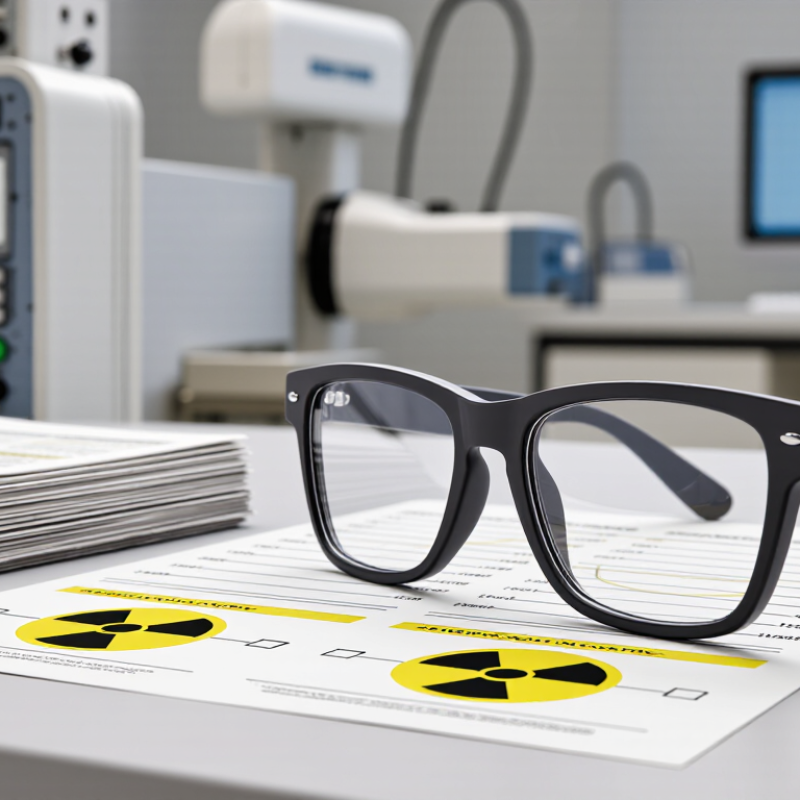
Define Your Radiation Protection and Workplace Requirements
Before comparing lead glasses suppliers, define the radiation exposure your team actually faces. Note the procedures performed, typical working distance, beam direction, and whether staff stand beside or behind the patient. Scatter can reach the sides of the face, so front-only coverage may not suit every task. Small details matter.
Ask a radiation safety professional to help assess the required lens protection for your equipment and workflow. Then check that a supplier provides clear specifications, including lens equivalence and coverage options. Compare those details with your workplace assessment, rather than choosing by appearance or price alone. Glasses are only one part of a protection program; they do not replace other controls or required protective equipment.
Fit deserves careful attention. Try frames with the masks, headwear, or prescription glasses staff actually use. Check for slipping, pressure at the temples, and gaps near the eyes during normal movement. Measure twice. A bulky frame may look reassuring but can be uncomfortable over a full shift. I may be giving fit extra weight, yet neglected comfort often means equipment is worn inconsistently. Record who will use the glasses, how they will be cleaned, and where they will be stored between procedures.
| Evaluation dimension | Requirement to define | What to verify with the supplier | Useful evidence or decision check |
|---|---|---|---|
| Radiation source and work task | Identify the imaging procedure, radiation source, typical working position, exposure direction, and whether the work is routine or occasional. | Can the supplier help match eyewear options to the actual procedure and explain the limits of the product’s protection? | Document the intended use with the facility’s radiation safety officer or medical physics team. Eyewear is supplemental protection and does not replace shielding, distance, or safe work practices. |
| Lead equivalence | Specify the required lead-equivalent thickness for the lenses and, where applicable, the side shields. The required value should be set for the workplace and procedure. | Does the supplier state the lead equivalence in millimetres of lead (mm Pb) and identify the test conditions or standard used to determine it? | Request product-specific test documentation. Lead equivalence depends on the X-ray beam quality and test method; values should not be compared without checking their stated conditions. |
| Applicable standards and regulations | Confirm the standards and regulatory requirements applicable in the country or region where the eyewear will be used. | Can the supplier provide a declaration or technical file identifying the relevant standard and the model it covers? | IEC 61331-3:2014 covers protective clothing, eyewear, and protective patient shields against diagnostic medical X-radiation. Confirm applicable editions and local requirements with the responsible radiation-protection specialist. |
| Lens coverage and side protection | Decide whether the work requires front-only coverage, wraparound coverage, or side shields, based on the exposure geometry and workplace assessment. | Are lens dimensions, side-shield options, and coverage information available for the specific frame configuration? | Compare the documented coverage with likely exposure directions. A frame’s appearance alone does not establish its radiation-protection performance. |
| Prescription and fit | Define whether prescription lenses, prescription inserts, or non-prescription eyewear are needed. Include fit requirements for different users. | Can the supplier provide the selected protective configuration with the required vision correction and fitting options? | Arrange a fit check with intended users. Confirm that the glasses remain stable, do not obstruct the field of view, and can be worn with any required personal protective equipment. |
| Weight and comfort | Estimate typical wear duration and identify comfort concerns, such as pressure on the nose or behind the ears. | Are product weight, frame dimensions, and available sizes documented? Can users evaluate a sample before a larger purchase? | Assess comfort during a representative work period. Heavier lenses may affect comfort, so balance fit and coverage with the protection specified for the task. |
| Optical quality | Specify the visual tasks that must remain clear, including close work, monitor viewing, and any required prescription correction. | Can the supplier provide information about lens clarity, optical distortion, coatings, and prescription compatibility? | Have users inspect vision and fit under normal workplace conditions. Confirm that any coating or customization applies to the selected protective model. |
| Product identification and traceability | Require clear identification of the model and its protection specification for purchasing, inspection, and replacement. | Are model identifiers and lead-equivalence information available on product labels, documentation, or both? | Keep the product documentation with purchasing and inventory records so the eyewear can be checked against the approved specification. |
| Quality documentation | Define what records are needed for internal approval and ongoing procurement. | Can the supplier provide technical specifications, test reports, instructions for use, and information on manufacturing quality controls? | Review product-specific evidence. An ISO 9001 certificate relates to a quality-management system; by itself, it does not prove the radiation-protection performance of a particular eyewear model. |
| Inspection, care, and replacement | Set a workplace process for cleaning, storage, inspection, and removal from service if eyewear is damaged. | Are care instructions and guidance on checking lenses and frames supplied? Can replacement parts or equivalent replacement models be identified? | Follow the manufacturer’s instructions and the facility’s radiation-protection program. Do not use eyewear with damage that could affect vision, fit, or protective coverage. |
| Supply and service capability | Set expected quantities, delivery timing, prescription-order needs, and the level of support required. | Can the supplier confirm lead times, ordering details, after-sales support, and how specification changes will be communicated? | Compare documented service commitments and the ability to supply the approved specification consistently; do not select on price alone. |
| Final approval | Record the approved model, intended users, protection specification, and responsible reviewer before purchase. | Will the supplier provide a final quotation and product documents that match the approved requirements? | Obtain approval from the appropriate workplace decision-makers, such as procurement and the radiation safety officer or medical physics team. |
| Important: There is no single lead-equivalence value or eyewear configuration that is suitable for every procedure or workplace. Set protection and fit requirements through a task-specific radiation-protection assessment and verify them against product-specific documentation. | |||