

NEWS AND UPDATES
The latest updates regarding our products and our company

Why Is Nervonic Acid in High Demand?
Nervonic Acid is attracting attention from researchers, ingredient makers, and companies developing specialized nutrition products. The interest is tied to its unusual structure: it is a very-long-chain monounsaturated fatty acid found in small amounts in certain plant oils and animal tissues. It is also present in sphingolipids, important components of nerve cell membranes. That connection makes it scientifically interesting. It does not, by itself, prove that taking a supplement improves nerve health.
Demand is growing in focused markets, not necessarily everywhere. Researchers are studying how Nervonic Acid is produced, absorbed, and used in the body. Manufacturers are exploring reliable sources, including selected oil-bearing seeds and fermentation-based production. For product developers, purity, consistency, and cost matter as much as the ingredient’s scientific appeal. A tiny detail can change the result: the fatty-acid profile may vary with the plant variety, growing conditions, and extraction method.
The interest is real, but the evidence needs careful reading. Early findings and biological theories should not be treated as established medical benefits. Human studies remain limited, and products can differ in formulation and quality. Still, the topic deserves attention. Its high-value niche reflects a mix of emerging research, specialized applications, and practical supply challenges—not a settled promise of better health. Understanding those factors helps explain why Nervonic Acid is in demand, and where caution remains essential.
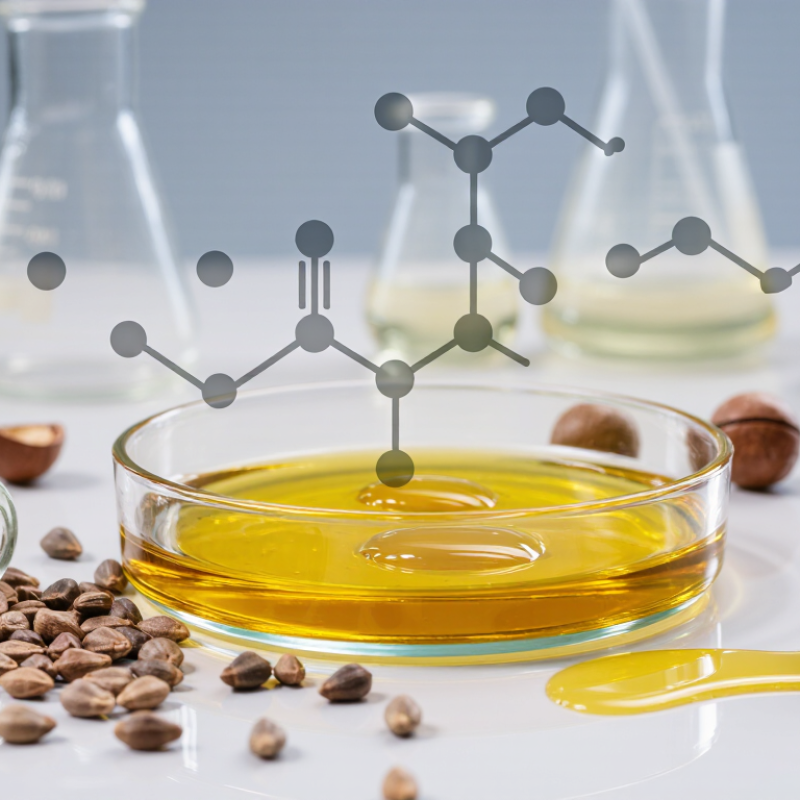
What Nervonic Acid Is and Where It Occurs Naturally
Why Is Nervonic Acid in High Demand?
Nervonic acid is a long-chain monounsaturated fatty acid, identified as 24:1 n-9. It occurs naturally in certain fats and in sphingolipids, a group of lipids found in cell membranes. It is especially associated with myelin, the insulating layer around nerve fibers. That role has drawn scientific interest, but it does not mean that eating more nervonic acid automatically improves nerve function.
Small amounts occur in some fish and plant seeds. Certain seed oils, including oils from Lunaria annua, can contain notably higher levels. The amount varies with the plant variety, growing conditions, and oil processing. Food labels rarely show nervonic acid separately, so it can be hard to estimate intake from an ordinary meal. A spoonful of oil looks simple; its fatty-acid profile is not. Researchers also study how the body makes and uses this fatty acid, but the details are still being worked out. The picture is not perfectly tidy. Natural occurrence is clear, while the effects of particular dietary amounts remain a more careful question.
| Data Dimension | Verified Information | Why It Matters |
|---|---|---|
| What nervonic acid is | Nervonic acid is a very-long-chain monounsaturated fatty acid, commonly written as 24:1 n-9 or C24:1. | Its unusually long carbon chain distinguishes it from many fatty acids found in common dietary oils. |
| Natural role in the body | It is present in sphingolipids, which are components of cell membranes and are abundant in the nervous system, including myelin. | Its association with myelin and nerve tissue is a major reason for scientific interest; this association alone does not establish a health benefit from supplements. |
| Plant source: Lunaria seeds | Seeds of some Lunaria species, including the plant commonly called honesty, are recognized sources of oils containing nervonic acid. | Oil composition varies by species, growing conditions, and processing; not all seed oils provide the same amount. |
| Plant source: Acer truncatum seeds | Seeds of Acer truncatum, a maple species, contain oil that can be a notable plant source of nervonic acid. | The concentration depends on the seed material and extraction method, so a specific value should be tied to a tested sample. |
| Other natural occurrence | Nervonic acid also occurs in small or variable amounts in certain animal and marine lipids and in the body's own lipids. | It is not a single-source nutrient, but its abundance in common foods is generally limited compared with its presence in specialized seed oils. |
| Why interest is growing | Interest is linked to its distinctive fatty-acid structure, its role in sphingolipids, and ongoing research into nervous-system lipids and potential applications. | “High demand” can describe market or research interest, but demand varies by region and product category and should not be taken as proof of clinical effectiveness. |
| Evidence and health claims | Research on nervonic acid and health outcomes is ongoing. Evidence from biochemical studies or animal research does not by itself demonstrate that supplementation prevents or treats disease in people. | Claims about memory, nerve repair, or treatment should be evaluated against human clinical evidence and applicable health regulations. |
| How source values are reported | Nervonic acid content is commonly reported as a proportion of the fatty acids in an analyzed oil, rather than as a fixed amount for every seed or food. | Comparisons are meaningful only when the sample, analytical method, and reporting basis are specified. |
How Nervonic Acid Supports Cell Membrane Structure
Nervonic acid is a very-long-chain monounsaturated fatty acid found in certain sphingolipids. These lipids are important components of cell membranes, especially in nervous tissue. Picture a nerve cell wrapped in layers of myelin: membrane lipids help form this insulating structure and support efficient signal transmission. Nervonic acid is one part of that complex mix, not a stand-alone building block.
Membranes are flexible, organized layers, not simple walls. Their lipid composition can affect how they pack and interact with proteins. Nervonic acid is associated with sphingolipids in myelin, so researchers study its role in membrane structure and nervous-system development. The science is still developing. A dietary source or supplement should not be assumed to change membrane composition or improve nerve function.
Tips: When evaluating a nervonic acid product or claim, look for human research and clear ingredient amounts. Food labels rarely explain how a fatty acid is incorporated into tissue. More is not automatically better. Ask a qualified health professional before using supplements, especially if you have a medical condition.
Which Foods and Oils Provide Nervonic Acid
Nervonic acid is uncommon in everyday foods, so the source matters. Malania oleifera seeds are among the richest documented sources. Peer-reviewed fatty-acid profiling of their oil reports about 55% nervonic acid among measured fatty acids—not 55% of the whole seed. That distinction is easy to miss. (Malania oleifera seed-oil composition studies.)
Acer truncatum seeds also yield an oil containing nervonic acid, but at a much lower level: compositional studies report roughly 5% of total fatty acids. The actual amount can vary with seed origin and processing. These figures describe specialist seed oils, not standard supermarket cooking oils. (Acer truncatum seed-oil fatty-acid analyses.)
For most people, these seeds are better understood as research-documented sources than routine dietary staples. Ordinary food tables rarely report nervonic acid, and reliable serving-size comparisons are limited. That leaves a gap. Fish and other foods may contain trace amounts, but the quantity depends on species and testing method; a food name alone cannot confirm a meaningful dose. Check whether a product’s analysis specifies nervonic acid as a percentage of fatty acids or as an amount per serving.
Why Is Nervonic Acid in High Demand?
Nervonic acid is a long-chain fatty acid found in especially high proportions in certain specialty seed oils.
Approximate ranges are shown as midpoint bars, with ranges in the tooltips. Values represent a percentage of each oil’s total fatty acids—not milligrams per serving—and can vary by seed variety and analysis. These specialty seed oils are not necessarily common cooking oils; ordinary foods are generally not concentrated sources.
How Nervonic Acid Is Used in Research and Nutrition
Nervonic acid is a very-long-chain fatty acid with 24 carbon atoms and one double bond. PubChem reports its molecular formula as C24H46O2 and molecular weight as 366.62 g/mol. In laboratory research, scientists measure it in lipid samples to study how fatty-acid composition relates to myelin and cell membranes. Chromatography can separate it from similar fatty acids; careful sample preparation matters. Small differences in extraction can shift the reported percentage.
Nutrition research asks a different question: how much nervonic acid occurs in foods or oils, and how does processing change that amount? Researchers typically report fatty-acid profiles as percentages, so a product’s source and batch analysis matter more than a broad label. There is no established daily requirement for nervonic acid in major dietary reference frameworks. That distinction matters. A measured food content is not proof of a health benefit. Evidence for dietary use remains limited, and findings from cells or animals do not establish effects in people. The evidence is uneven, and that deserves more attention than confident claims.
What Is Driving Demand for Nervonic Acid and Its Supply Challenges
Nervonic acid is a very-long-chain fatty acid found in sphingolipids, important components of nerve-cell membranes and myelin. That biological role has drawn attention from nutrition researchers and developers of specialized lipid ingredients. Interest is growing, but it should not be confused with proof that supplements improve cognition or treat disease. Human evidence remains limited.
Supply is less straightforward than the molecule’s name suggests. Some oilseed plants can provide nervonic acid, yet the amount varies with species, growing conditions, and seed quality. A processor may need many kilograms of seed to obtain a relatively small quantity of concentrated oil. Then come extraction, purification, and testing for fatty-acid composition and contaminants. Each step adds cost. Small batches can be especially difficult to standardize.
There is a practical tension here. Buyers want consistent purity and traceable sourcing, while growers and processors need reliable yields and workable prices. Expanding production may depend on better crop varieties, improved processing, or fermentation-based methods, each requiring careful quality checks. Not every proposed route will scale well. The market’s real size is also hard to judge, because research demand and commercial demand are often discussed together. That distinction deserves more attention.
Article Source:
Schedule
Monday to Thursday:
8:15 – 17:00
Friday:
8:00-15:00
Address
Leonardo Da Vinci, 10
Valencia Technology Park
46980 Paterna, Valencia, SPAIN
Real Laboratory SL
info@site_e1c8a3bd-d539-4d7f-8695-37f21373de39
Teléfono: +34 96 136 61 07
