

• NEWS AND UPDATES

    The latest updates regarding our products and our company

Top 10 Skin Analysis Machines for Global Buyers

For global buyers, choosing a Skin Analysis Machine is not simply a matter of counting cameras, sensors, or software features. A reliable system should produce consistent images, explain measurable findings, and support responsible consultation. It should examine hydration, pigmentation, pores, texture, redness, and visible lines under controlled lighting. Accuracy matters more than impressive screens.

Dermatologist and cosmetic science educator Dr. Zoe Diana Draelos has emphasized a practical principle: “A measurement is only useful when it changes patient care.” That idea should guide every purchasing decision. The best machine helps professionals compare progress, communicate clearly, and recommend suitable care without exaggerating results. It should not replace clinical judgment.

Look closely at calibration, image repeatability, data security, training, warranty support, and compatibility with existing consultation systems. A bright 3D face map may attract attention. It may also confuse clients if its scoring method is unclear. Ask whether the supplier publishes technical specifications and explains testing conditions. Request demonstrations using different skin tones, ages, and lighting environments. Real-world performance can differ from a polished showroom display.

This guide reviews ten leading options for international buyers. It considers practical usability, diagnostic support, software quality, service coverage, and long-term value. Some models are excellent for clinics. Others suit beauty retailers or mobile consultations. None is perfect. Buyers may still face incomplete documentation, regional service limits, or inconsistent results between operators. That uncertainty deserves attention, not marketing language. A careful comparison can reduce costly mistakes and support more transparent skin consultations worldwide.
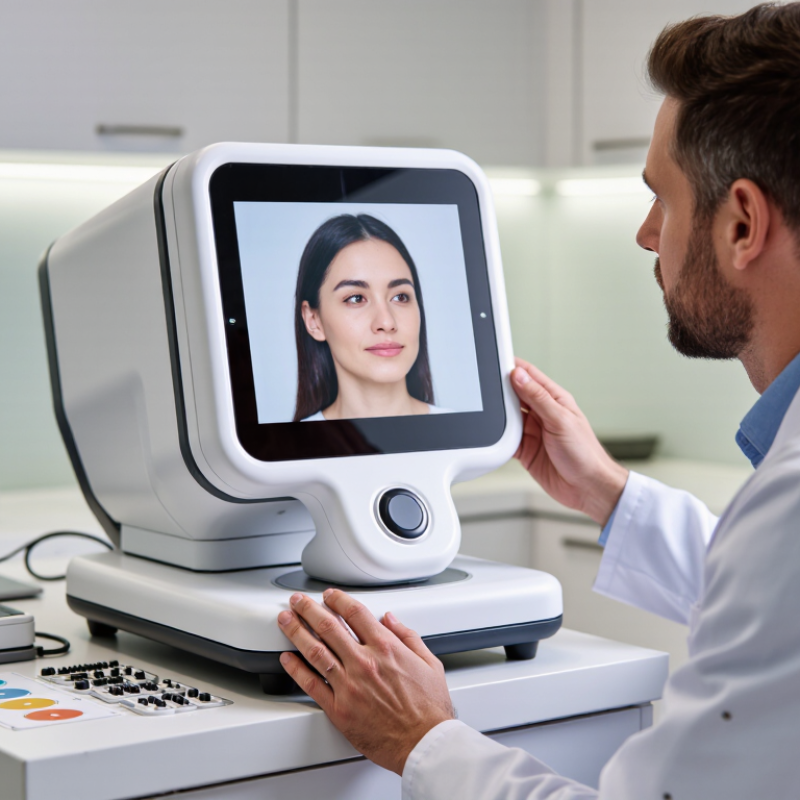
Top 10 Skin Analysis Machines for Global Buyers

What Skin Analysis Machines Measure and Why It Matters

Skin analysis machines convert visible and near-infrared signals into measurable skin indicators. They commonly assess hydration, surface oil, pigmentation, redness, pore appearance, fine lines, and texture. Some systems also measure transepidermal water loss, or TEWL, which reflects barrier performance more directly. However, image-based results are estimates, not medical diagnoses.

The World Health Organization reported in 2023 that nearly 1.8 billion people live with a skin condition at any moment. Reliable assessment therefore matters in clinics, salons, and research settings. Hydration readings can guide moisturizer selection, while sebum data may support oil-control routines. Polarized or ultraviolet images can reveal uneven pigmentation that ordinary lighting misses. Yet accuracy depends on calibration, room temperature, recent cleansing, and camera distance. A shiny forehead may reflect lighting, not excess oil. That limitation deserves more attention.

Tips: Test clean, makeup-free skin under consistent lighting. Repeat scans at similar times. Compare trends, not one dramatic score. Ask whether the device measures hydration directly or only predicts it from images. A 2022 review in Skin Research and Technology highlighted substantial variation among skin-measurement methods, so operators should record device settings and conditions. Numbers can look precise. They are not always certain. Professional judgment, client history, and clinical referral remain essential when a lesion changes, bleeds, or causes persistent discomfort.

How to Compare Imaging, Sensing, and AI Analysis Technologies

Top 10 Skin Analysis Machines for Global Buyers

How to Compare Imaging, Sensing, and AI Analysis Technologies

Choosing among the top ten skin analysis machines requires more than counting cameras. Imaging systems capture pores, pigmentation, redness, and wrinkles under controlled lighting. Polarized light can reveal surface contrast. Ultraviolet imaging may show hidden pigment patterns, but results depend on calibration and room conditions. Sensing systems measure hydration, oil, elasticity, or temperature. These readings are useful only when the probe touches skin consistently. Small pressure changes can alter results.

AI analysis adds speed, yet it is not automatically objective. A 2020 JAMA Dermatology meta-analysis reported approximately 87% sensitivity and 91% specificity for artificial intelligence in skin cancer image classification. That evidence concerns trained clinical images, not every commercial beauty scanner. The World Health Organization has reported that skin conditions affect nearly 1.8 billion people at any time. This scale makes representative datasets important. Buyers should ask whether training images include varied ages, skin tones, lighting conditions, and lesion types. Many machines still provide attractive scores without clear validation. That deserves skepticism.

Tips: Request repeatability data, not only accuracy claims. Test the same volunteer three times. Compare results across operators. Check export formats, calibration procedures, privacy controls, and language support. A device that produces detailed images but poor measurements may impress customers and mislead practitioners. I would also examine whether the software separates cosmetic observations from medical alerts. That boundary is easy to blur. Better documentation usually matters more than a longer feature list.

Top 10 Skin Analysis Machines for Global Buyers - How to Compare Imaging, Sensing, and AI Analysis Technologies

Rank Machine Type Primary Imaging / Sensing Technology Typical Measurements AI Analysis Level Main Output Typical Scan Time Best-Fit Users Key Limitation
1 Multi-Spectral Facial Analyzer Visible light, polarized light, ultraviolet illumination, and near-infrared imaging Wrinkles, pores, pigmentation appearance, redness, texture, and UV-visible spots Advanced Images, scores, maps, and trend reports 1–3 minutes Dermatology clinics, aesthetic centers, research-led retailers Results depend strongly on lighting, positioning, cosmetics, and image-standardization procedures
2 Standardized Cross-Polarized Imaging System Cross-polarized photography with controlled illumination Surface redness, uneven pigmentation, visible lesions, pores, and fine lines Moderate to advanced Comparable facial images and numerical skin scores 1–2 minutes Clinics and professional consultation environments Primarily assesses optical appearance rather than deep tissue structure or true physiological values
3 High-Resolution 3D Facial Scanner Structured light or multi-camera 3D surface capture Facial geometry, contour, volume, wrinkles, folds, and treatment-area changes Advanced 3D models, depth maps, and before-and-after comparisons 2–5 minutes Plastic surgery, aesthetic medicine, and treatment documentation Higher cost and more demanding capture conditions; surface data do not equal diagnostic evidence
4 Polarized and UV Imaging Station Polarized visible light combined with UV fluorescence or UV-reflectance imaging Redness, surface oil patterns, pigmentation contrast, and UV-visible damage patterns Basic to moderate Diagnostic-support images and visual comparison panels 1–3 minutes Skin-care consultations, education, and product demonstrations UV patterns are affected by sunscreen, cosmetics, sebum, and camera calibration
5 AI Camera-Based Skin Assessment Kiosk RGB camera imaging with computer-vision segmentation and machine-learning models Visible wrinkles, pores, spots, texture, redness, and facial-area comparisons Advanced software; hardware-dependent Automated scores, recommendations, and customer profiles 30–90 seconds Retail stores, beauty chains, and high-volume consultations AI accuracy varies with training data, skin tones, camera setup, and software validation
6 Handheld Dermatoscope with Digital Imaging Magnified polarized or non-polarized close-up imaging with LED illumination Lesion structures, pigment patterns, vascular features, and localized skin details Basic to advanced, depending on software Magnified images and clinician-reviewed records Seconds to 2 minutes Dermatology practices and focused lesion documentation Small field of view; image assistance does not replace professional diagnosis or pathology
7 Corneometer-Style Hydration and Oil Meter Electrical capacitance or conductance for hydration; sebum-film measurement for surface oil Relative stratum-corneum hydration and surface sebum level Low; rule-based reporting is common Point measurements and category scores 5–30 seconds per site Beauty retailers, spas, cosmetic testing, and routine monitoring Measurements are local and sensitive to cleansing, temperature, humidity, pressure, and probe contact
8 Transepidermal Water Loss Measurement System Open-chamber or closed-chamber water-vapor flux sensing Water loss from the skin surface as an indicator related to barrier function Low to moderate Quantitative flux values and barrier-monitoring trends 1–5 minutes per site Cosmetic research, dermatology studies, and formulation testing Strongly affected by airflow, ambient humidity, temperature, acclimatization, and probe handling
9 Skin Surface Temperature and Erythema Sensor Non-contact infrared thermography and/or optical erythema sensing Relative temperature distribution, redness-related optical signals, and treatment response patterns Moderate Thermal maps, color indices, and time-based comparisons Seconds to 2 minutes Aesthetic treatment monitoring and controlled skin studies Ambient conditions, recent exercise, vasodilation, and camera emissivity assumptions influence results
10 Portable Smartphone-Connected Skin Analyzer Phone camera, clip-on magnification or illumination, and cloud or mobile AI analysis Visible spots, pores, wrinkles, redness, texture, and basic skin-type indicators Moderate; software-dependent Mobile reports, product guidance, and longitudinal records 30–120 seconds Mobile consultations, field sales, home monitoring, and entry-level retail Variable phone cameras, lighting, distance, angle, privacy controls, and internet availability affect consistency
Buyer note: Scan times, measurement ranges, and AI capabilities are typical industry characteristics rather than fixed specifications. For international procurement, verify calibration procedures, software validation across diverse skin tones, data-protection compliance, language support, electrical certification, warranty coverage, and local service availability. Skin-analysis outputs should support consultation and monitoring, not replace clinical diagnosis.

Key Features Shared by the Top 10 Skin Analysis Machines

Top 10 Skin Analysis Machines for Global Buyers

Key Features Shared by the Top 10 Skin Analysis Machines

The strongest ten machines share a practical foundation: controlled lighting, multi-spectrum imaging, and repeatable measurements. They capture visible redness, pigmentation, pores, wrinkles, oil, and hydration in one session. According to Grand View Research, the global aesthetic devices market is expanding steadily, driven by non-invasive assessment and treatment demand. That trend increases the need for reliable skin data, not attractive screenshots.

Accuracy starts with consistency. The better systems guide the user’s face position, distance, and expression. Some include polarized, ultraviolet, and cross-polarized images, revealing details missed by ordinary cameras. AI then compares findings with reference databases and produces treatment-oriented reports. However, AI is not a clinician. Its results depend on lighting, camera calibration, skin tone, and database quality. This is often overlooked.

Useful features also include automatic calibration, multilingual interfaces, encrypted storage, consent controls, and exportable PDF reports. These details matter to clinics serving international customers. The American Academy of Dermatology recommends professional evaluation for changing or suspicious lesions; therefore, a scanner should support consultation, not replace diagnosis. Frost & Sullivan’s industry analyses repeatedly identify workflow integration and data security as important growth factors in medical technology. Still, more measurements do not always mean better decisions. I would question any machine that presents a precise score without showing its method, limitations, or testing conditions. Clear evidence beats impressive graphics.

Top 10 Skin Analysis Machines for Global Buyers

Key Features Shared by the Top 10 Skin Analysis Machines

This industry-reference benchmark summarizes the most commonly available capabilities in professional skin analysis systems. Multispectral imaging, facial-zone analysis, and digital skin reporting are widely used, while hydration, sebum, sensitivity, and elasticity measurements may require dedicated sensors or accessories.

Global Standards, Certifications, and Regional Compliance Requirements

Top 10 Skin Analysis Machines for Global Buyers

Global Standards, Certifications, and Regional Compliance Requirements

A skin analysis machine is not automatically a medical device. Its classification depends on intended use, claims, software, and contact with users. A product describing hydration or pore appearance may remain cosmetic. Claims about diagnosis or treatment can trigger stricter controls. Claims matter.

The ISO Survey 2023 recorded more than 28,000 ISO 13485 certificates worldwide, showing the importance of structured medical-device quality systems. Buyers should request an ISO 13485 certificate, risk-management records under ISO 14971, and electrical safety testing under IEC 60601-1. Software-based analyzers may also require IEC 62304 documentation. These documents should match the exact model, not a similar product.

Regional rules still differ. In the European Union, medical claims may require conformity with Regulation (EU) 2017/745 and CE marking. United States buyers should verify the applicable FDA pathway, including registration, listing, or clearance requirements. China, Japan, South Korea, and Australia apply separate authority processes and local-language labeling expectations. The World Health Organization’s Global Model Regulatory Framework for Medical Devices supports risk-based oversight, but it does not replace national approval. Grand View Research’s 2024 medical aesthetics report projects strong market growth through 2030, increasing pressure on importers to verify compliance before purchase.

A certificate alone is not enough. I would also check calibration intervals, cybersecurity controls, clinical evidence, and after-sales records. Many purchasing teams overlook those details. That gap is dangerous.

How International Buyers Can Select, Purchase, and Deploy the Right Machine

International buyers should treat a skin analysis machine as a workflow investment, not a shiny camera. McKinsey’s 2023 beauty report projected the global beauty market could approach 590 billion dollars by 2028. The Global Wellness Institute valued the wellness economy at 6.3 trillion dollars in 2023. Demand is strong, but purchasing decisions still require discipline.

Start with purpose. Define whether the machine supports consultations, product recommendations, progress tracking, or professional assessment. Compare image resolution, lighting control, sensor functions, software languages, data export, and user permissions. Ask for validation data from comparable skin types and operating conditions. Claims need evidence. Request calibration procedures, test reports, cybersecurity documents, warranty terms, and spare-part timelines before payment. ISO 13485 certification can show a mature quality system, but it does not prove diagnostic accuracy.

Local classification matters. Confirm import duties, electrical standards, privacy requirements, and whether the device can legally make clinical claims. Deployment often fails quietly. Train staff using one written protocol: identical distance, clean skin, controlled lighting, and fixed follow-up intervals. Store consent records and images securely, with defined access rights and retention periods. A practical pilot should involve several operators before full rollout. Review false positives, missed findings, customer complaints, and repair delays. That review may expose weak assumptions. A sales demonstration cannot replace independent evaluation.