
• NEWS AND UPDATES

    The latest updates regarding our products and our company

10 Tips for Choosing Laboratory Supplies and Equipment

Choosing laboratory supplies and equipment is rarely a simple purchasing task. A reliable balance, centrifuge, or pipette can influence every result produced in a laboratory. Small errors may begin with unclear specifications, poor calibration, or unsuitable materials. I have seen teams compare prices carefully, yet overlook maintenance access and user training. That oversight can become expensive.

This guide presents ten practical tips for making better purchasing decisions. It considers accuracy, durability, compatibility, safety features, cleaning requirements, and long-term service support. A glass bottle may appear suitable, but chemical resistance and closure quality still need confirmation. A compact freezer may save space, while consuming more energy than expected. Details matter.

Evidence should guide the final choice. Review technical documents, calibration records, warranty terms, and independent user feedback. Ask suppliers about replacement parts and response times, not only delivery dates. Accredited testing, documented quality systems, and transparent specifications can strengthen confidence. Still, no checklist removes every uncertainty. Laboratory conditions change, and equipment performance can differ between environments. That is why trial evaluations and clear acceptance criteria remain valuable.

The right purchase supports consistent work, safer handling, and efficient budgets. It should also fit the people who use it daily. Consider reach, visibility, noise, and cleaning effort. Practical experience often reveals problems that brochures hide. Thoughtful selection is not about buying the most advanced product. It is about choosing dependable laboratory supplies and equipment for the work actually being performed. Even experienced teams should review their assumptions. That habit protects both results and resources.
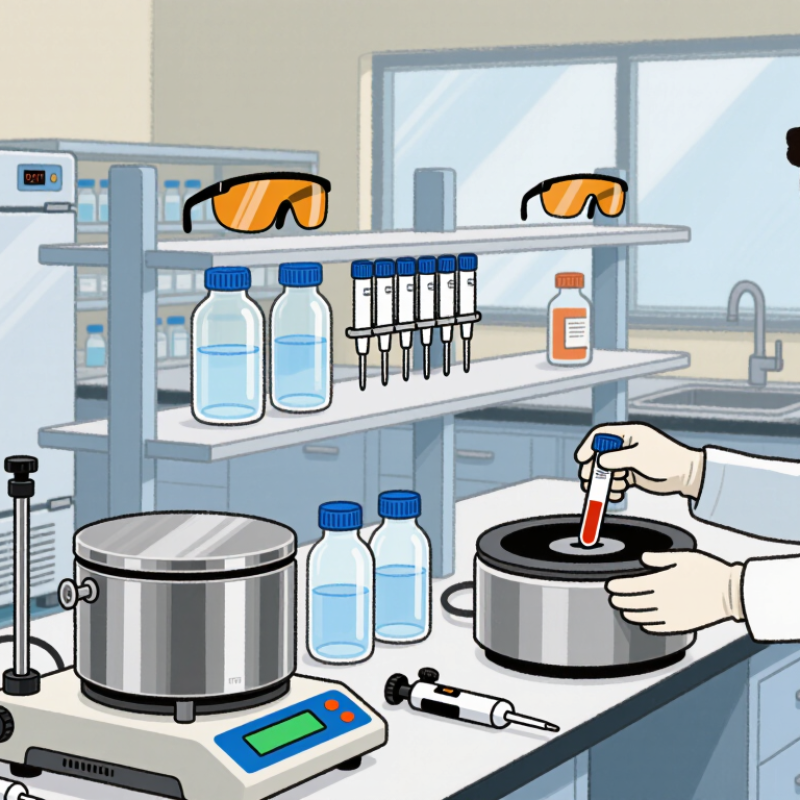
10 Tips for Choosing Laboratory Supplies and Equipment

Define the Laboratory’s Purpose and Operational Requirements

Before choosing laboratory supplies and equipment, define what the laboratory must accomplish. A teaching room needs durable, simple tools. A quality-control laboratory may require tighter measurement, traceability, and controlled workflows. Research spaces often need flexibility because protocols change.

Write the purpose in practical terms. Identify sample types, testing volume, temperature ranges, required accuracy, and user skill levels. For example, a laboratory processing 200 samples daily needs different storage and preparation capacity than one handling ten samples weekly. Map each task from receiving to disposal. Note where contamination, delays, or recording errors could occur. Small details matter.

I once underestimated bench space around a compact analytical instrument. The equipment fit, but operators struggled to load samples safely. That mistake changed our planning process. We now measure access routes, service clearances, electrical capacity, ventilation, and cleaning areas before purchasing. We also check calibration needs, maintenance schedules, spare parts, and staff training requirements. Reliable records should show who used each instrument and when.

Do not rely only on product specifications. Compare them with actual operating conditions. Ask qualified users to test representative workflows when possible. Review safety procedures and applicable local requirements with responsible professionals. A lower purchase price may create higher costs through downtime, consumables, or difficult maintenance. Some requirements will remain uncertain, and that is normal. Document those assumptions, then revisit them after the laboratory has operated for several weeks.

Compare Material Quality, Compatibility, and Technical Specifications

10 Tips for Choosing Laboratory Supplies and Equipment

Compare Material Quality, Compatibility, and Technical Specifications

Choosing laboratory supplies should begin with material quality, not appearance. Inspect glass for uniform thickness, clear surfaces, and smooth rims. Borosilicate glass handles repeated heating better than ordinary glass. Stainless steel may resist corrosion, but its grade still matters. Check the material certificate when chemical exposure is significant.

Compatibility must match the actual workflow. A container suitable for water may fail with strong solvents. Review resistance to acids, bases, oils, pressure, and temperature changes. Check seals, tubing, and gaskets separately. They often contact the sample first. I once overlooked a gasket’s temperature limit, causing a small leak during heating. The equipment was sound. My selection was not.

Technical specifications should be measurable and relevant. Compare accuracy, resolution, capacity, tolerance, operating range, and calibration requirements. A balance showing more decimal places is not automatically more accurate. Ask for calibration records traceable to recognized standards. Confirm dimensions, power requirements, connector types, and cleaning methods before ordering. Keep a written comparison table. It exposes missing details. However, I sometimes give too much weight to specifications and too little to daily handling. A difficult lid, awkward display, or fragile clamp can reduce reliable use. Trial fitting, staff feedback, and documented inspection provide evidence that catalog claims alone cannot offer.

Evaluate Safety Features, Compliance, and User Protection

Choosing laboratory supplies is a safety decision, not merely a purchasing exercise. The U.S. Bureau of Labor Statistics reported 2.4 recordable injury and illness cases per 100 full-time private-industry workers in 2023. Laboratory teams should examine how equipment reduces exposure, not only how efficiently it performs.

Look for physical guards, lid interlocks, spill containment, emergency shutoffs, clear alarms, and stable controls. A centrifuge should prevent opening during rotation. A heating device should limit unexpected temperature changes. Protective design matters most when users are tired or rushed. The WHO Laboratory Biosafety Manual, fourth edition, recommends risk assessment before selecting controls. Match the equipment to the hazard, task, and user skill level.

Compliance evidence should be practical and traceable. Request conformity documents, test records, maintenance instructions, calibration intervals, and accessible safety data. Check whether electrical protection and ventilation requirements fit your facility. The National Institute for Occupational Safety and Health emphasizes the hierarchy of controls, placing engineering controls above administrative reminders and personal protective equipment. That order is easy to overlook.

User protection also depends on daily reality. Can staff clean the surface without awkward reaching? Can they read the display through protective eyewear? Are replacement parts available? A perfect specification sheet cannot prevent poor training. I have seen teams overvalue capacity and underestimate noise, heat, and maintenance time. That judgment deserves review. Safety is never finished.

Assess Maintenance Needs, Reliability, and Supplier Support

Choosing laboratory supplies by purchase price alone is a costly shortcut. Maintenance requirements often decide whether equipment serves reliably for five years. In my lab work, neglected seals, clogged filters, and overdue calibration caused more disruption than dramatic hardware failures. Small faults become expensive. Before ordering, request the maintenance schedule, calibration interval, spare-part lead time, and technician training requirements. These details reveal ownership costs that catalogs rarely show.

Reliability needs evidence, not confident promises. Ask for documented uptime, failure-rate definitions, service-response targets, and records from comparable laboratories. ISO’s 2023 Survey reported more than one million ISO 9001 certificates worldwide, but certification alone does not prove equipment reliability. That distinction matters. Request acceptance-test criteria and a clear corrective-action process. The U.S. Department of Energy’s Operations and Maintenance Best Practices Guide estimates that effective maintenance can reduce operating costs by 5% to 20%.

Supplier support should be tested before purchase. Call the service line with a technical question and measure the response time. Confirm local coverage, loaner availability, software updates, and escalation contacts. Put every promise in writing. Reliability is shared. I have occasionally overvalued polished demonstrations and undervalued repair logistics. That mistake remains a useful warning. Choose suppliers that explain failure handling plainly, even when the answer is inconvenient.

10 Tips for Choosing Laboratory Supplies and Equipment

Typical Preventive Maintenance Intervals for Common Laboratory Equipment

Preventive maintenance intervals commonly range from six to twelve months. pH meters generally require more frequent calibration because electrode performance changes with use, while balances, centrifuges, microscopes, pipettes, and fume hoods are commonly reviewed or calibrated at least annually. Actual schedules should follow the equipment manual, usage intensity, risk level, and laboratory quality system.

Plan the Budget, Purchasing Process, and Future Expansion

10 Tips for Choosing Laboratory Supplies and Equipment

Plan the Budget, Purchasing Process, and Future Expansion

Begin with the work, not the catalog. List required tests, sample volumes, safety controls, and expected operating hours. Then create a budget covering purchase, installation, training, calibration, maintenance, and disposal. The lowest price is rarely the lowest cost. Keep a contingency reserve of 10–15% for delivery changes or missing accessories. Small items matter.

Compare specifications against actual procedures. Ask for written quotations with clear lead times, warranties, service terms, and replacement-part availability. Use a scoring sheet instead of relying on memory. Include technical staff, safety personnel, and finance colleagues in the review. Their concerns may differ. Check dimensions, power requirements, ventilation, water connections, and software compatibility before approval. A crowded bench creates daily problems. Document every decision and retain inspection records after delivery.

Purchase in phases when the budget is limited. Protect essential equipment first, while delaying noncritical upgrades. Select modular systems when future testing may require additional capacity. Leave space around instruments for access, ventilation, and repairs. Confirm that floors, electrical circuits, and waste systems can support later expansion. A three-year growth estimate is useful, but it will be wrong sometimes. Review it every six months. I once underestimated storage needs because I counted instruments, not consumables. That mistake changed our layout and purchasing schedule. Reliable planning accepts correction, rather than pretending every forecast is certain.

10 Tips for Choosing Laboratory Supplies and Equipment - Plan the Budget, Purchasing Process, and Future Expansion
Tip Planning Dimension Practical Data or Benchmark Recommended Purchasing Action Future Expansion Consideration
1 Define the workflow first List each process from sample receipt and preparation through analysis, storage, waste handling, and reporting. Create an equipment schedule that identifies the required capacity, accuracy, throughput, utilities, and operator qualifications for every process step. Reserve space and utility connections for additional instruments or parallel workflows instead of designing only for the initial workload.
2 Set a total cost of ownership budget Include purchase price, installation, qualification, calibration, consumables, preventive maintenance, utilities, training, software, and eventual disposal. Compare at least a three-year ownership cost rather than selecting equipment solely by its initial price. Record recurring costs separately so future capacity increases can be forecast using actual consumption and service data.
3 Match capacity to sample volume Calculate expected samples per day, run time per batch, changeover time, rejection rate, and required turnaround time. Choose capacity with a practical operating buffer; avoid relying on maximum advertised throughput for routine planning. Use modular instruments, interchangeable rotors, additional shelves, or parallel units where workload growth is likely.
4 Specify accuracy and measurement range An analytical balance commonly provides 0.1 mg readability, while a top-loading balance is generally selected for less sensitive weighing. Write the required accuracy, repeatability, linearity, measurement range, and environmental conditions into the technical specification. Choose equipment that can accommodate future methods without exceeding its calibrated range or measurement uncertainty.
5 Check storage temperature and capacity Common laboratory storage ranges include 2–8 °C for refrigerated materials, approximately −20 °C for frozen materials, and approximately −80 °C for ultra-low-temperature storage. Define usable internal volume, temperature uniformity, alarm functions, access frequency, and backup requirements before purchase. Leave room for inventory growth and consider independent backup storage for irreplaceable samples or critical reagents.
6 Verify facility and utility requirements Confirm electrical voltage and current, heat output, water supply, drainage, compressed air, ventilation, floor loading, door clearance, and network connectivity. Obtain a written site-preparation checklist and complete a facilities review before issuing the purchase order. Install appropriately sized utility capacity, spare outlets, data points, and accessible isolation points for later equipment additions.
7 Include safety and compliance needs Risk controls may include chemical fume extraction, biological containment, guards, interlocks, emergency power, alarms, and safe waste segregation. Base specifications on the hazards of the materials and processes, and verify applicable occupational safety, electrical, fire, and environmental requirements. Use segregated zones and scalable safety infrastructure so higher sample volumes do not compromise containment or emergency access.
8 Evaluate consumables and compatibility Check tube size, plate format, filter material, chemical compatibility, sample-contact materials, sterile status, and required storage conditions. Test representative consumables with the intended equipment before committing to large-volume purchasing. Prefer standardized formats and commonly available consumables to reduce supply risk and simplify expansion across workstations.
9 Plan purchasing and qualification stages A controlled process normally includes user requirements, technical evaluation, quotation review, purchase approval, delivery inspection, installation, qualification, and acceptance testing. Use weighted evaluation criteria covering performance, service support, documentation, delivery schedule, training, and total cost. Maintain approved specifications, acceptance-test templates, and equipment records so additional units can be evaluated consistently.
10 Prepare for maintenance and expansion Track calibration intervals, preventive-maintenance dates, downtime, failure history, spare parts, software support, and operator training. Define service response expectations, warranty coverage, backup procedures, and ownership of maintenance records before installation. Use utilization and downtime data to decide when to add capacity, replace equipment, or introduce automation rather than waiting for repeated bottlenecks.
Planning note: The temperature ranges, balance readability, and workflow controls shown above are commonly used laboratory planning references. Confirm exact performance specifications, facility requirements, and compliance obligations against the applicable method, local regulations, and risk assessment.